- USS
Saratoga CV-3
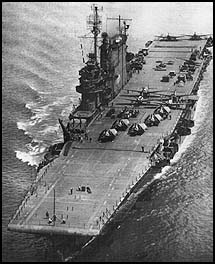 Commissioned
in 1927, an American aircraft carrier 880 feet in length and weighs
39,000 tons, it rests in Bikini's lagoon at a depth of 190 feet. Her
bridge is easily accessible at 40 feet, her deck at 90 feet, and the
hanger for the Helldivers at 125 feet. These Helldivers and bombs
are still on display complete with all dials and controls. Saratoga
had a fuel capacity of 63,200 barrels of fuel oil, 249 barrels of
diesel oil, and 132,264 gallons of gasoline. Fuel and ammunition
loads during test BAKER were 10% of capacity and 67% capacity
respectively. She was reported sunk by the Japanese seven times
during World War II. She received seven battle stars.
Commissioned
in 1927, an American aircraft carrier 880 feet in length and weighs
39,000 tons, it rests in Bikini's lagoon at a depth of 190 feet. Her
bridge is easily accessible at 40 feet, her deck at 90 feet, and the
hanger for the Helldivers at 125 feet. These Helldivers and bombs
are still on display complete with all dials and controls. Saratoga
had a fuel capacity of 63,200 barrels of fuel oil, 249 barrels of
diesel oil, and 132,264 gallons of gasoline. Fuel and ammunition
loads during test BAKER were 10% of capacity and 67% capacity
respectively. She was reported sunk by the Japanese seven times
during World War II. She received seven battle stars.
Eight hours after the waves created by the atomic Baker blast rolled over her, New York Times correspondent Hanson W. Baldwin wrote this epitaph as he watched the Saratoga sink slowly beneath Bikini's lagoon: "There were many who had served her in the observing fleet and they fought with her through the long hot hours as the sun mounted. Outside the reef...the observing ships cruised, while the Sara slowly died. There were scores who wanted to save her-and perhaps she might have been saved, had there been a crew aboard. But she died a lonely death, with no man upon the decks once teaming with life, with pumps idle and boilers dead. From three o'clock on she sank fast, her buoyancy gone, as the fleet kept the death watch for a 'fighting lady.' The Sara settled-the air soughing from her compartments like the breath from exhausted lungs. At 3:45 p.m. the starboard aft corner of her flight deck was awash; then the loud speakers blared: 'The water is up to her island now; the bow is high in the air.' She died like a queen-proudly. The bow slowly reared high; the stern sank deep, and, as if striving for immortality, the Sara lifted her white numeral 3 high into the sun before her bow slipped slowly under. Her last minutes were slow and tortured; she fought and would not sink, but slowly the 3 was engulfed by the reaching waters, the tip of her mast was the last bit of Sara seen by man." Unless, of course, you are a diver fortunate enough to be visiting Bikini Atoll! The USS Saratoga is the largest diveable vessel in the world, and the only aircraft carrier available for diving. 880 feet long. (3 buoys: bow, stern and bridge).
-
HIJMS Nagato
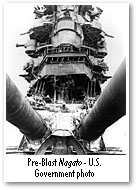
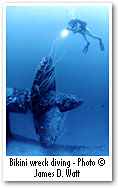 The
Japanese Flagship to the Japanese Navy, she was Admiral Isoroku
Yamamoto's floating fortress during Japan's World War II attack on
Pearl Harbor and was a treasure to the Japanese forces. Japanese
Naval historian Masanori Ito wrote: "When World War II began, the
Japanese Navy-the third most powerful in the world-included some of
the mightiest ships in naval history and was a force worthy of the
pride and trust of the Japanese people. Then, in less than four
years, this great war machine fell from glory to oblivion. Of ten
battleships riding in Hiroshima Bay in December of 1941, nine were
sunk. The lone survivor, the Nagato, died at Bikini as a target in
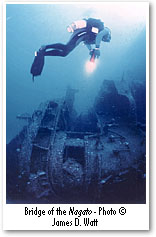
an atomic bomb test." The 32,720 ton battleship is at rest upside
down in 170 feet of water; her bridge is accessible at 150 feet, the
hull and monstrous props at 110 feet. The Nagato was built by Kure
Naval Dockyard, launched on Novemver 9, 1919, and completed on
November 25, 1920. She was reconstructed in 1934-1936, with torpedo
bulges, increased elevation for main armament, aircraft crane, etc.
After this refit, Nagato had 10 Kampon boilers, driving 4 sets of
Kampon turbines developing 82,300 shaft
The
Japanese Flagship to the Japanese Navy, she was Admiral Isoroku
Yamamoto's floating fortress during Japan's World War II attack on
Pearl Harbor and was a treasure to the Japanese forces. Japanese
Naval historian Masanori Ito wrote: "When World War II began, the
Japanese Navy-the third most powerful in the world-included some of
the mightiest ships in naval history and was a force worthy of the
pride and trust of the Japanese people. Then, in less than four
years, this great war machine fell from glory to oblivion. Of ten
battleships riding in Hiroshima Bay in December of 1941, nine were
sunk. The lone survivor, the Nagato, died at Bikini as a target in
an atomic bomb test." The 32,720 ton battleship is at rest upside
down in 170 feet of water; her bridge is accessible at 150 feet, the
hull and monstrous props at 110 feet. The Nagato was built by Kure
Naval Dockyard, launched on Novemver 9, 1919, and completed on
November 25, 1920. She was reconstructed in 1934-1936, with torpedo
bulges, increased elevation for main armament, aircraft crane, etc.
After this refit, Nagato had 10 Kampon boilers, driving 4 sets of
Kampon turbines developing 82,300 shaft
 horsepower
(shp) for a speed of 25 knots. Her fuel bunkerage was now 5,650 tons
of oil, giving her a radius of 8,650 nautical miles at 16 knots. Her
new dimensions were 725' 9" long at the waterline, 113' 6" beam, 32'
2" draught. Her normal displacement was 39,130 tons, 42,850 tons at
full load. She carried a crew of 1,368. In June 1944 she was known
to be fitted with radar. By October 1944 her armament consisted of 8
x 16"/45, 18 x 5.5"/50 [guns that were later removed], 8 x 5"/40,
and 98 x 25mm AA guns. Her displacement had by now increased to
43,581 tons full load, and as a result her maximum speed was 24.98
knots. By the end of the war she had had her main mast and funnel
removed for camouflage purposes, as she was holed up in Sagami Bay
near Yokosuka. Fuel and ammunition loads during both ABLE and BAKER
tests were, respectively, 15% and 10% of capacity. She is upside
down in the water and an incredible dive with her four massive
screws appearing like an underwater Stonehenge. 708 feet long. (2
buoys)
horsepower
(shp) for a speed of 25 knots. Her fuel bunkerage was now 5,650 tons
of oil, giving her a radius of 8,650 nautical miles at 16 knots. Her
new dimensions were 725' 9" long at the waterline, 113' 6" beam, 32'
2" draught. Her normal displacement was 39,130 tons, 42,850 tons at
full load. She carried a crew of 1,368. In June 1944 she was known
to be fitted with radar. By October 1944 her armament consisted of 8
x 16"/45, 18 x 5.5"/50 [guns that were later removed], 8 x 5"/40,
and 98 x 25mm AA guns. Her displacement had by now increased to
43,581 tons full load, and as a result her maximum speed was 24.98
knots. By the end of the war she had had her main mast and funnel
removed for camouflage purposes, as she was holed up in Sagami Bay
near Yokosuka. Fuel and ammunition loads during both ABLE and BAKER
tests were, respectively, 15% and 10% of capacity. She is upside
down in the water and an incredible dive with her four massive
screws appearing like an underwater Stonehenge. 708 feet long. (2
buoys)
See a small U.S. Park Service sketch of the Nagato as she rests on Bikini Atoll's lagoon.
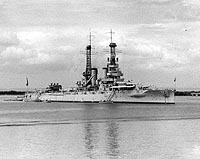 A
29,000 ton American battleship that survived two world wars had a fuel
capacity of 37,779 barrels of fuel oil, 119 barrels of diesel oil, and
4,000 gallons of gasoline. The Arkansas took part in the Presidential
Naval Review in the Hudson River, October 14, 1912 and then carried
President William H. Taft to the Panama Canal Zone for an inspection of
the unfinished canal. On April 22, 1914, she assisted in the occupation
of Veracruz, Mexico. In December of 1918 she formed part of the escort
carrying President Woodrow Wilson to France. In World War II, the
Arkansas escorted convoys across the Atlantic. She remained in European
waters for the invasion of Normandy where she performed yeoman service
at Omaha Beach, the bombardment of Cherbourg and the invasion of
southern France. She then moved to the Pacific to participate in action
at Iwo Jima and Okinawa. The Arkansas, at rest almost completely upside
down in Bikini's lagoon in 170 feet of water, received four battle stars
for her service in World War II and was sunk by BAKER. 562 feet long. (1
buoy)
A
29,000 ton American battleship that survived two world wars had a fuel
capacity of 37,779 barrels of fuel oil, 119 barrels of diesel oil, and
4,000 gallons of gasoline. The Arkansas took part in the Presidential
Naval Review in the Hudson River, October 14, 1912 and then carried
President William H. Taft to the Panama Canal Zone for an inspection of
the unfinished canal. On April 22, 1914, she assisted in the occupation
of Veracruz, Mexico. In December of 1918 she formed part of the escort
carrying President Woodrow Wilson to France. In World War II, the
Arkansas escorted convoys across the Atlantic. She remained in European
waters for the invasion of Normandy where she performed yeoman service
at Omaha Beach, the bombardment of Cherbourg and the invasion of
southern France. She then moved to the Pacific to participate in action
at Iwo Jima and Okinawa. The Arkansas, at rest almost completely upside
down in Bikini's lagoon in 170 feet of water, received four battle stars
for her service in World War II and was sunk by BAKER. 562 feet long. (1
buoy)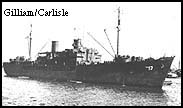 A
merchant craft named after a county in Kentucky, she had fuel capacity
of 9,695 barrels of fuel oil and 375 barrels of diesel oil. She made
three voyages to the west coast from Hawaii and Japan and shorter
passages among South Pacific islands. She sits upright on the bottom and
is guarded by a magnificent school of skip jacks; and there is almost
always a shark siting on this ship. The ABLE blast split her open so she
makes for a sensational penetration dive. Fuel and ammunition loads
during test ABLE were 95% of capacity. The Carlisle was sunk by the ABLE
blast. 426 feet long. (1 buoy).
A
merchant craft named after a county in Kentucky, she had fuel capacity
of 9,695 barrels of fuel oil and 375 barrels of diesel oil. She made
three voyages to the west coast from Hawaii and Japan and shorter
passages among South Pacific islands. She sits upright on the bottom and
is guarded by a magnificent school of skip jacks; and there is almost
always a shark siting on this ship. The ABLE blast split her open so she
makes for a sensational penetration dive. Fuel and ammunition loads
during test ABLE were 95% of capacity. The Carlisle was sunk by the ABLE
blast. 426 feet long. (1 buoy).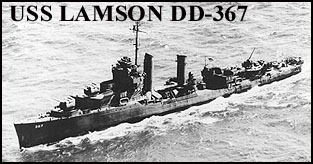 The
American destroyer Lamson received five battle stars for service during
World War II. She was used to search for Amelia Earhart in 1937 in the
Marshall and Gilbert Islands. She was deployed from Pearl Harbor on
December 7, 1941, in the unsuccessful search for the Japanese Task Force
that bombed Pearl Harbor and later served throughout the Pacific until
the end of the war. Her fuel capacity was 3,600 barrels, her diesel oil
capacity was 110 barrels, and she was at 50% capacity for both fuels and
ordnance when she was sunk by ABLE. Her hull provides a great example of
the power of a nuclear explosion as it is horribly twisted and damaged.
She is a Bikini divemaster favorite. 341 feet long. (1 buoy).
The
American destroyer Lamson received five battle stars for service during
World War II. She was used to search for Amelia Earhart in 1937 in the
Marshall and Gilbert Islands. She was deployed from Pearl Harbor on
December 7, 1941, in the unsuccessful search for the Japanese Task Force
that bombed Pearl Harbor and later served throughout the Pacific until
the end of the war. Her fuel capacity was 3,600 barrels, her diesel oil
capacity was 110 barrels, and she was at 50% capacity for both fuels and
ordnance when she was sunk by ABLE. Her hull provides a great example of
the power of a nuclear explosion as it is horribly twisted and damaged.
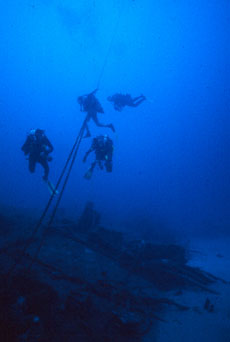
She is a Bikini divemaster favorite. 341 feet long. (1 buoy).See more technical information about the USS Lamson.
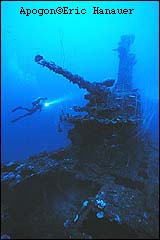 An
American submarine with normal fuel capacity of 54,000 gallons, and an
emergency load of 116,000 gallons. She made eight war patrols sinking
three Japanese vessels totaling 7,575 tons. Her first patrol was out of
Pearl Harbor in November of 1943. She later patrolled from Majuro to
Midway and was part of Operation Galvanic during the invasions of Tarawa
and the Gilbert Islands. Working off Formosa, she ran in a wolf-pack
known as the "Mickey Finns" that sunk 41,000 tons worth of Japanese
vessels toward the end of the war. She received five battle stars and
was sunk by BAKER. She now appears perfectly upright as if ready to
drive away on the bottom of Bikini's lagoon. Eric Hanauer of Discover
Diving commented, "The shadowy silhouette of Apogon's conning tower,
completely enveloped by glassy sweepers, is one of the most beautiful
sights I've ever seen underwater." 312 feet long. (1 buoy)
An
American submarine with normal fuel capacity of 54,000 gallons, and an
emergency load of 116,000 gallons. She made eight war patrols sinking
three Japanese vessels totaling 7,575 tons. Her first patrol was out of
Pearl Harbor in November of 1943. She later patrolled from Majuro to
Midway and was part of Operation Galvanic during the invasions of Tarawa
and the Gilbert Islands. Working off Formosa, she ran in a wolf-pack
known as the "Mickey Finns" that sunk 41,000 tons worth of Japanese
vessels toward the end of the war. She received five battle stars and
was sunk by BAKER. She now appears perfectly upright as if ready to
drive away on the bottom of Bikini's lagoon. Eric Hanauer of Discover
Diving commented, "The shadowy silhouette of Apogon's conning tower,
completely enveloped by glassy sweepers, is one of the most beautiful
sights I've ever seen underwater." 312 feet long. (1 buoy)See more technical information about the USS Apogon.
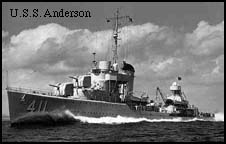 An
American destroyer that received ten battle stars during World War II.
She served as a carrier screen in the Coral Sea, Midway, the Solomons,
Guadalcanal, and Tarawa. Always on the frontlines, she was with the
Lexington CV-2 and the Yorktown CV-5 aircraft carriers when they were
sunk in battle by the Japanese. She was also with the USS Wasp and the
USS Hornet when they were sunk in WWII. In 1943, in Wotje Atoll in the
Marshall Islands, she got hit with a 155mm shell that killed the captain
and five officers and wounded another 18 men. She carried 2929 barrels
of fuel oil and 168 barrels of diesel oil and was at 95% of capacity of
both fuel and ordnance when she was sunk by ABLE and is now at rest on
her side in Bikini's lagoon. 348 feet long. (1 buoy)
An
American destroyer that received ten battle stars during World War II.
She served as a carrier screen in the Coral Sea, Midway, the Solomons,
Guadalcanal, and Tarawa. Always on the frontlines, she was with the
Lexington CV-2 and the Yorktown CV-5 aircraft carriers when they were
sunk in battle by the Japanese. She was also with the USS Wasp and the
USS Hornet when they were sunk in WWII. In 1943, in Wotje Atoll in the
Marshall Islands, she got hit with a 155mm shell that killed the captain
and five officers and wounded another 18 men. She carried 2929 barrels
of fuel oil and 168 barrels of diesel oil and was at 95% of capacity of
both fuel and ordnance when she was sunk by ABLE and is now at rest on
her side in Bikini's lagoon. 348 feet long. (1 buoy)- USS
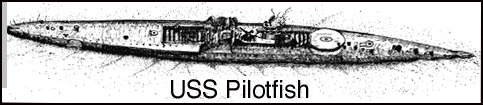
Pilotfish SS-386
An American submarine with normal fuel capacity of 54,000 gallons, she made five war patrols during WWII. Fuel and ammunition loads during test BAKER were 95% of capacity. She received five battle stars, patrolled the Northern Marianas, Bonin Islands, the East China Sea, and the southeast coast of Japan. She was featured in ABC's World of Discovery Emmy nominated production about Bikini Atoll, "Forbidden Paradise." She is on her side and half-buried in the sand. 312 feet long. (1 buoy). - Below: The
Pilotfish as it rests on Bikini Atoll's lagoon [US Park Service]
-
 The
Sakawa, a Japanese ship, was built in Sasebo Naval Dockyard, and
launched on April 9, 1944. She was the only vessel of its class to
survive the war. Nominal armament 6 x6"/50 (interestingly, these guns
were refitted secondary weapons from earlier ships, like the Kongo-class
battleships), 4 x 80mm AA, approx. 61 x 25mm AA, 8 x 24" torpedo tubes,
16 depth charges, 1 catapult, and 2 floatplanes. Length 563 feet at the
waterline, 571 feet overall, 49' 10" beam, 18' 5" draught.
The
Sakawa, a Japanese ship, was built in Sasebo Naval Dockyard, and
launched on April 9, 1944. She was the only vessel of its class to
survive the war. Nominal armament 6 x6"/50 (interestingly, these guns
were refitted secondary weapons from earlier ships, like the Kongo-class
battleships), 4 x 80mm AA, approx. 61 x 25mm AA, 8 x 24" torpedo tubes,
16 depth charges, 1 catapult, and 2 floatplanes. Length 563 feet at the
waterline, 571 feet overall, 49' 10" beam, 18' 5" draught.
She had 4 shaft geared turbines from 6 Kampon boilers for 100,000 shp and 35 knots and carried 1,405 tons fuel oil for a 6,300 nautical mile radius at 18 knots. The Sakawa was surrendered to the U.S. at Maizuru in August of 1945, then used for repatriation duties until taken to Bikini where she was sunk by ABLE with an unknown fuel load and apparently no ordnance. 532 feet long as she rests in Bikini's lagoon in an upright position. (1 buoy)
 Ships
Not Buoyed at the Bottom of Bikini Lagoon
Ships
Not Buoyed at the Bottom of Bikini Lagoon4
- LCT-414
LCT-812
LCT-1114
LCT-1175
LCT-1187
LCT-1237
LOM-60
The aforementioned "L" vessels were landing craft with little known history. Some were sunk in the lagoon, some were towed to sea and sunk after the tests, and at least one was "obliterated."